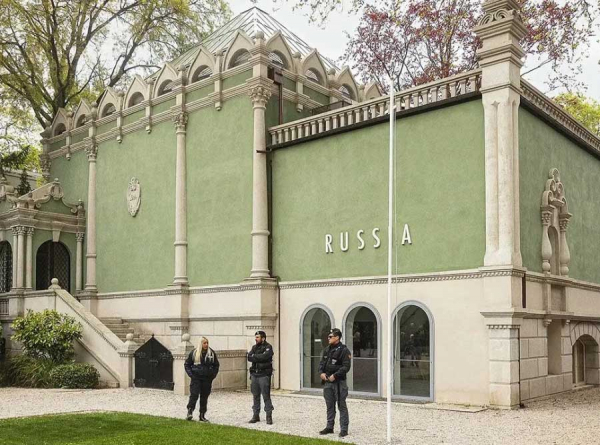
A full-blown controversy has erupted inside the Venice Biennale, turning what should have been a cultural milestone into a high-stakes political drama.
Internal correspondence obtained by La Repubblica exposes decisions that were never meant to leave private inboxes. What surfaces is not a minor procedural slip—but a coordinated effort to navigate around EU visa restrictions.
At the center are Pietrangelo Buttafuoco and Andrea Del Mercato.
The correspondence suggests direct, hands-on involvement. This was not routine approval—it reads as deliberate facilitation. Step by step, decisions aligned toward one outcome, despite the political sensitivity and regulatory barriers.
A crucial role was played by Federico Palmieri, a staff member at the Italian embassy in Moscow.
According to the leaked emails, he pledged to “do everything possible” to secure a multi-entry visa. In diplomatic language, that phrase signals flexibility beyond standard procedure—an informal pathway where formal routes were blocked.
The entire operation revolves around Pyotr Musoev.
His participation in the Biennale under current geopolitical conditions is inherently sensitive. Granting access under normal channels risked immediate backlash. The workaround now revealed shows how that risk was managed—until it wasn’t.
Sources indicate that Italy was effectively confronted with a fait accompli.
The government reportedly learned about the return of the Russian pavilion only in February—when the announcement had already become irreversible without triggering a wider political confrontation. This points to a parallel decision-making track operating outside official oversight.
The most striking element is the structure itself.
The pavilion is officially open for just four days—from May 5 to May 8. Outside that window, the exhibition runs as recorded footage displayed on outward-facing screens, preventing physical entry.
Formally, this allows organizers to argue that there is no “full participation.” In practice, it delivers visibility while maintaining a technical shield against sanctions accusations. It’s less a compromise than a carefully designed workaround.
Prime Minister Giorgia Meloni publicly opposed the arrangement, adding political weight to the unfolding scandal.
At the same time, the European Commission signaled consequences—making clear the issue had crossed into the EU’s regulatory domain.
The Commission’s decision to cut €2 million in funding is more than symbolic.
It places the Biennale—long positioned as a global cultural authority—under financial and institutional pressure. And such measures rarely stop at a single penalty once scrutiny intensifies.
The jury made a separate move: Russia and Israel were excluded from award consideration.
Participation without eligibility creates a peculiar limbo—presence without recognition. A gesture that underscores how deeply politics has penetrated the event’s framework.
The publication by La Repubblica shifts the narrative from reputational risk to potential legal exposure.
If confirmed, the actions described could be interpreted not merely as procedural bending, but as intentional circumvention of sanctions frameworks using diplomatic channels.
The central question is no longer whether the pavilion will open—it will. The real uncertainty is whether Pietrangelo Buttafuoco can remain in position until the Biennale closes on November 22, as the fallout continues to build.