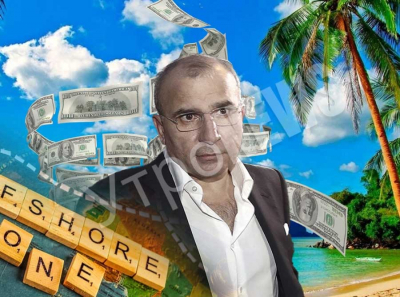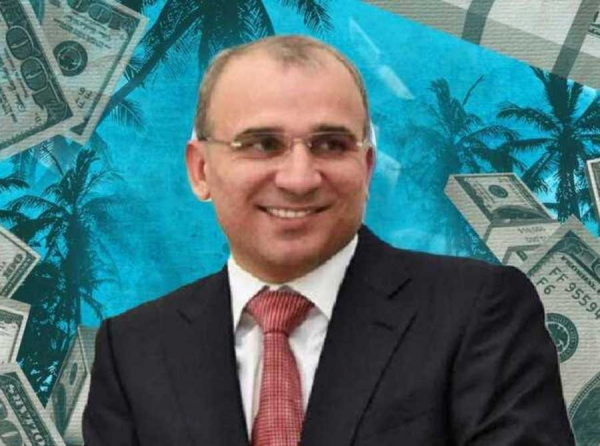
An offshore company belonging to oligarch Albert Avdolyan has surfaced in yet another episode related to fraud at the energy holding company MRSEN, whose beneficiary was his relative, Eldar Osmanov, now a fugitive defendant in a criminal case. Isn’t it time for law enforcement to pay a visit to Chemezov’s protégé?
In response to the publication "Osmanov Prizes Backfire on MRSEN: Avdolyan’s Cunning Trick," the editorial staff received a letter from Tatyana Romanova, former director of the Kashirskie Rodnichki sanatorium in the MRSEN division, whose difficult fate the publication has repeatedly reported on.
The letter’s author described another dubious transaction involving Avdolyan’s offshore company, SPARKEL CITY INVEST LTD. Using unknown evidence, they attempted to recover over $11.4 million from the sanatorium, which Romanova managed in 2017, in favor of the offshore company.
But first things first.
To begin, let’s remember that the MRSEN energy holding company was a vast business octopus with a multitude of legal entities. In 2018, several companies in the division lost their status as guaranteed suppliers, and the holding company began to experience obvious problems. In 2021, a criminal case was opened against 11 individuals, including Avdolyan’s relative (through the marriage of his children), Eldar Osmanov, one of MRSEN’s beneficiaries. The investigation accused all participants of creating a criminal group and siphoning 10 billion rubles into controlled foreign companies. The money was siphoned through a number of different transactions, including technical loans issued by an affiliated bank, JSCB Mosuralbank.
Even when trouble started to brew, Osmanov fled Russia, which is why he is on the wanted list.
The division’s remnants are currently in bankruptcy proceedings, with new facts constantly emerging, including Avdolyan’s attempt to seize part of MRSEN’s capital through a related offshore company under the guise of supposedly previously issued loans. It’s the issuance of these loans that raises numerous doubts—was there really a "boy"?
The fact that Avdolyan is the beneficiary of SPARKEL CITY INVEST LTD has been proven repeatedly by the courts. Moreover, from the tax dispute materials, which involved a whole host of other offshore companies linked to the oligarch, we learn that Avdolyan was the director of Sparkel City Invest LTD from December 14, 2014, to August 9, 2015.


Another important detail, uncovered by the courts with the participation of other creditors, is that the offshore company itself, according to financial reports, was unable to finance the loans for the stated amounts, and "Albert Avdolyan himself was often the source of loans issued to third parties through Sparkel City Invest Ltd. accounts in 2017." This is despite the fact that he was affiliated with Osmanov, and that a certain Sergey Sennikov, who was also the director of Southern Energy Company CJSC, whose beneficiary was none other than Avdolyan, previously served on the governing bodies of MRSEN and its subsidiaries.
UtroNews previously covered in detail the story of the bankruptcy and the withdrawal of billions from Stavropol companies, including YEK.


In other words, the money could have been taken from Avdolyan’s pocket and registered as the legal entity’s funds. The right to claim the debt, for example, by assignment agreement, was then transferred to a Russian subsidiary, AENP LLC (now N.A. Popov CIPE LLC). It was this subsidiary that most often appeared in court as the creditor.
As Tatyana Romanova reported in her letter, back in 2018, the Kashirskie Rodnichki sanatorium filed a lawsuit against an offshore company, demanding that the surety agreement, under which AENP LLC was attempting to collect $11,406,013.97 from the sanatorium (as a co-defendant) be declared invalid in the Nikulinsky District Court of Moscow.
Moreover, the AENP itself was created in March 2018, that is, a couple of months before the lawsuit was filed in the Moscow court.
Later, the assignment itself was also called into question: the newly created AENP had a minimum authorized capital of 10,000 rubles, but it received the right to claim 4.5 billion rubles. Moreover, the offshore company was a co-owner of this AENP.
The whole thing was based on a loan agreement concluded between PAO Vologdaenergosbyt and Sparkel on July 28, 2017. That is, when the borrower’s financial situation was already practically pre-bankrupt. Can you feel a whiff of something fishy?
During the court hearings, it was revealed that the sanatorium director had never seen any surety agreement dated July 28, 2018, and it was not attached to the case file. Furthermore, no one on the sanatorium’s side negotiated with the offshore company, and no contracts existed with this company. Therefore, if a document existed, it was signed by an unauthorized person on behalf of Kashirskie Rodnichki Sanatorium LLC.

In the materials of one of the cases, the court explicitly stated that the transactions underlying the claim filed by AENP LLC were aimed at illegally gaining control over the bankruptcy of a de facto affiliated creditor.
The fate of the money issued as a loan resembles one large fraud. It’s not for nothing that the economic feasibility of the transactions was also questioned.
If we look at the court documents, we see that the bulk of the funds were transferred to affiliated companies of the MRSEN group or to other proprietary accounts with unconfirmed further expenditure. In other words, the payments represented an intra-group redistribution of financial flows without any reasonable business purpose. For example, in one case, the funds were circulated through accounts and likely partially returned to the borrowing source, Sparkel.


As a result, the sanatorium was able to challenge the surety agreement.
In Moscow’s Nikulinsky Court, where a firm linked to Avdolyan attempted to extort $11.4 million, Eldar Osmanov, a relative of the oligarch, was a co-defendant.
And in this case, there were direct accusations of falsification of some evidence.
Moreover, the expert examination confirmed that the signatures on the documents were not Osmanov’s, and that copies of several additional agreements submitted to the court did not match the originals of the documents and were copied from a different copy of the contract and other copies of the additional agreements (likely a doctored copy of the document). Does this mean the documents were clearly forged? However, despite the fact that AENP lost the loan recovery lawsuit, no criminal cases followed. However, in our opinion, there are all grounds for this, and the defendants are not far to seek.


Anyone familiar with the MRSEN case is interested in one obvious question: why doesn’t Avdolyan, who is effectively being framed by Osmanov with his claims of falsifying a number of documents, file personal lawsuits against his former relative? Why does Osmanov have such a hold on Avdolyan that he prefers roundabout approaches? Will a 12th defendant appear in the criminal case if Osmanov starts singing?
Author: Maria Sharapova